


''Oral History'' Video Interviews
SUBTITLE
In February 2026, project Sounding Spomenik initiated a dedicated series of ''Oral History'' Video Interviews: an ever growing body of structured and recorded conversations designed to document first-hand memories, experiences, interpretations, and perspectives connected to the Yugoslav era monuments of the revolution. The initiative forms an important extension of the project's broader interdisciplinary research into the memorial landscapes of the former Yugoslavia. While the project has from its beginnings approached these monuments through sounds, field recordings, and architectural observations, the ''Oral History'' Video Interview series introduces another crucial dimension: the voices of people who have encountered, studied, remembered, cared for, interpreted, or otherwise developed a personal or professional relationship with these built memorial sites.
The interviews are conceived not simply as conventional biographical conversations, but as forms of situated knowledge: each testimony emerges from a particular relationship between an individual, a monument, and the historical and social environment in which that monument exists. The selected speakers bring different forms of expertise and experience to the conversation, including personal memories, professional research, artistic practice, local knowledge, cultural activism, architectural interpretation, and reflections on the constantly changing political meanings of the memorial landscape.
Through this initiative, Sounding Spomenik seeks to preserve voices and viewpoints that might otherwise remain undocumented or gradually disappear. The project recognizes that knowledge about monuments is not contained solely in archives or scholarly publications. The oral history series is therefore conceived as both a documentation project, and an ongoing act of cultural preservation. By recording these testimonies in the present, the project creates an archive through which future generations may encounter not only the monuments themselves but also the ways in which people living in their vicinity, researching them, interpreting them, or caring for them understood their significance.
László Juhász
February 2026
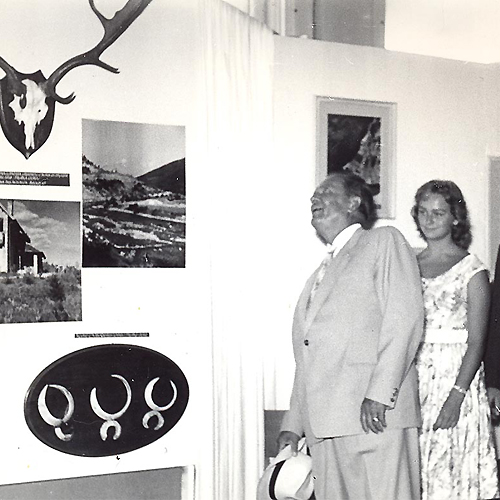
Art historian Irina Subotić in Kranj in 1959 as Tito's personal guide at the Tourism Fair. Archive photo
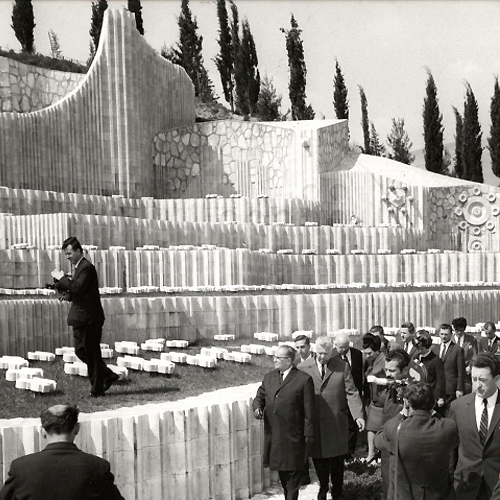
Tito's visit at the Partisan Memorial Cemetery in Mostar on 8 April 1969. Archive photo
IRINA SUBOTIĆ
BELGRADE, FEBRUARY 2026
Dr. Irina Subotić (1941), a distinguished Serbian art historian, has held curatorial positions at two of Serbia's largest and most important cultural institutions, namely: the Museum of Contemporary Art Belgrade and the National Museum of Serbia. She has also served as Professor of Modern Art History at both the University of Belgrade Faculty of Architecture, and the Academy of Arts in Novi Sad. Among her many professional contributions, she was one of the founding members of the South East European (SEE) Heritage Network, and has led the Serbian branch of Europa Nostra. Holding the title of professor emerita, she has authored numerous influential scholarly studies, as well as a substantial body of books and monographs.
In the 17-minute oral history interview, Dr. Subotić adopts a broad analytical perspective on the Yugoslav era monuments of the revolution. She addresses the emergence of abstract art in Yugoslavia, the processes through which monument design proposals were evaluated and selected, and the influence of Josip Broz Tito's personal aesthetic preferences in shaping artistic production. Furthermore, she reflects on the prevalence of modernist design within its specific historical and regional context, and discusses the œuvre of architect Bogdan Bogdanović, with a particular emphasis on his notable work at the Jasenovac Memorial Site.
In the 17-minute oral history interview, Dr. Subotić adopts a broad analytical perspective on the Yugoslav era monuments of the revolution. She addresses the emergence of abstract art in Yugoslavia, the processes through which monument design proposals were evaluated and selected, and the influence of Josip Broz Tito's personal aesthetic preferences in shaping artistic production. Furthermore, she reflects on the prevalence of modernist design within its specific historical and regional context, and discusses the œuvre of architect Bogdan Bogdanović, with a particular emphasis on his notable work at the Jasenovac Memorial Site.
ĐURO TRKULJA
LUŠCI PALANKA, JULY 2026
Đuro Trkulja (1939) is one of the people whose personal biography has become inseparable from the history of the memorial site at Grmeč. A teacher of history, curator, researcher, guide, later poet, writer and local historian from Lušci Palanka in northwestern Bosnia-Herzegovina, Trkulja spent ten years working at the Korčanica Memorial Area on Mount Grmeč where he welcomed generations of visitors and youth groups, explaining the history of the wartime partisan hospital and the wider Partisan complex that once existed in the forests of Grmeč. Today, when much of the physical memorial has been abandoned and neglected, Đuro Trkulja himself has become an important bearer of its memory.
When Trkulja started to work at Grmeč as a guide in 1982, the Korčanica Memorial Area was not simply an isolated monument complex in the forest: it was a functioning institution, and a destination for guided visits from across Yugoslavia. For the next ten years, until the outbreak of war in 1992, Đuro Trkulja worked there as curator and researcher. He later recalled those ten years as the happiest ten years of his life. The monument at Grmeč was designed to preserve the memory of a wartime generation, and eventually, Trkulja became one of the most important people who preserved the memory of the monument itself.
When Trkulja started to work at Grmeč as a guide in 1982, the Korčanica Memorial Area was not simply an isolated monument complex in the forest: it was a functioning institution, and a destination for guided visits from across Yugoslavia. For the next ten years, until the outbreak of war in 1992, Đuro Trkulja worked there as curator and researcher. He later recalled those ten years as the happiest ten years of his life. The monument at Grmeč was designed to preserve the memory of a wartime generation, and eventually, Trkulja became one of the most important people who preserved the memory of the monument itself.
RONALD PANZA
MOSTAR, JULY 2026
Ronald Panza (1972) is a literary scholar, writer, researcher, and cultural activist from Mostar, Bosnia-Herzegovina. With an academic background in comparative literature and theatre studies, Panza has developed an interdisciplinary practice situated at the intersection of literature, theatre, sound art, urbanism, cultural memory, and the politics of public space. His work is deeply rooted in his hometown, where he has spent years exploring how the city's architecture, monuments, and cultural practices shape collective memory and contemporary life.
A central figure in Ronald Panza's intellectual and artistic work is the architect Bogdan Bogdanović, whose work has occupied his research for more than a decade. Panza's engagement with Bogdanović extends beyond academic study: he has treated Bogdanović's ideas as a means of understanding Mostar itself, particularly questions of memory, urban space, civic life, and the relationship between the living city and its monuments.
His research culminated in the book entitled Bogdanović Vocabulary, published in 2023, a collection and interpretation of concepts, expressions, and linguistic constructions drawn from Bogdanović's writings. Panza has contributed to the effort to keep the Partisan Cemetery present in the cultural consciousness of contemporary Mostar. Rather than treating the monument simply as a historical relic, his work approaches it as a living space of memory and as a place through which questions about the city can still be asked.